
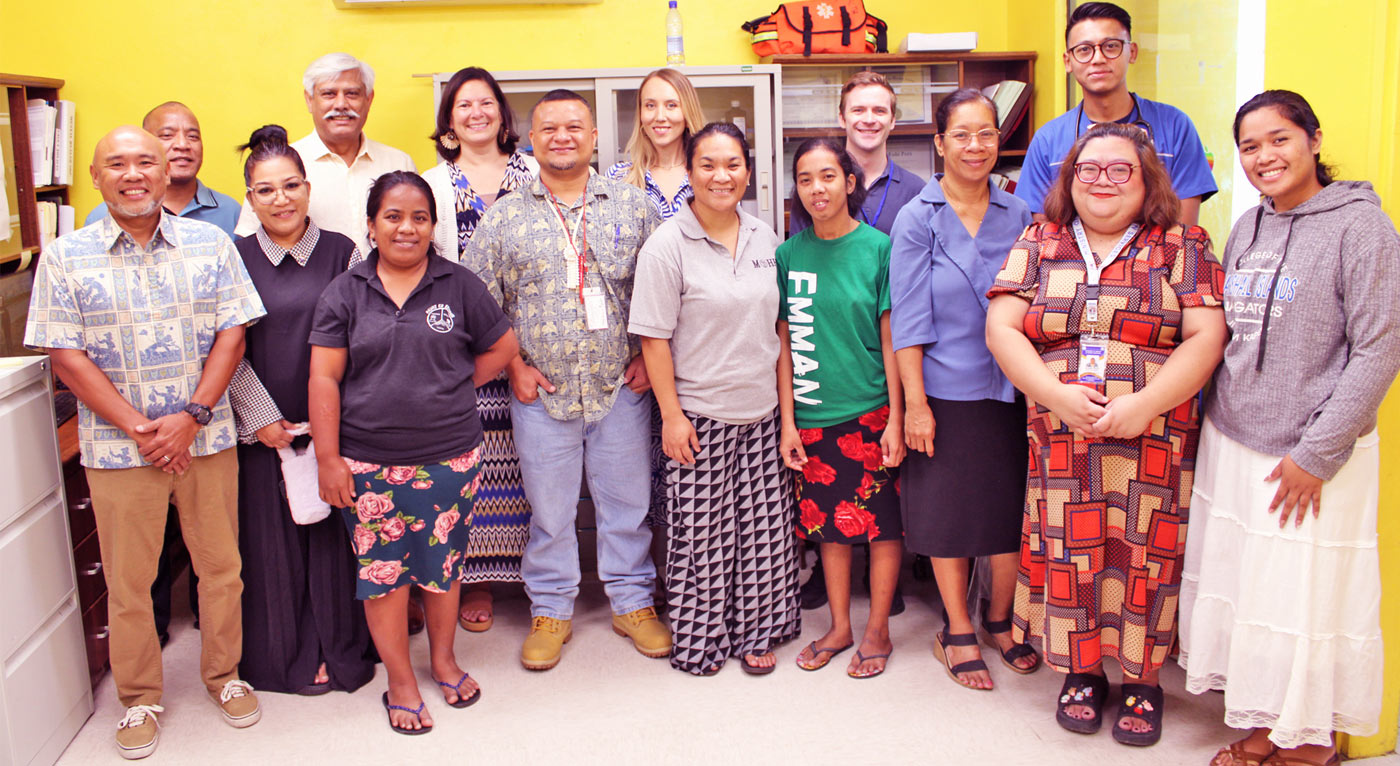
Photo: Giff Johnson.
A partnership between two government ministries is opening opportunities for families to access autism screening for their children and follow up support for their needs.
The Ministry of Health and Human Services and the Public School System last week formally launched the country’s first National Autism Referral System and Database, aimed at improving support for children with developmental needs.
The system was introduced during an open Autism Screening Day held on 26 March
at the Behavioral Health Clinic at Majuro hospital. Strong community interest was evident, with families arriving before the official 10am start and over 26 children receiving
screenings that day.
The new system strengthens coordination between health and education services,
allowing for improved identification, referral, and ongoing support for children and their
families. This initiative represents an important step forward for families in the Marshall Islands.
The initiative has been supported through collaboration between Dr. Holden Nena, a
psychiatrist who is the clinical director for Human Services, with technical assistance from World Bank Autism and Neurodiversity Advisor Kristin Bartlett.
Since the beginning of 2026, through the new database system, 63 autism-related cases have been identified, highlighting the need for coordinated national support systems.
Families who have concerns about their child’s development are encouraged to visit the
Behavioral Health Clinic on Thursdays.
In related developments, Public School System teachers and students are engaging to develop classroom environments for neurodiverse students.
Across the Marshall Islands, classrooms are evolving to foster inclusion for all learners. Through collaboration between the Public School System (PSS) and World Bank Autism and Neurodiversity Advisor Kristin Bartlett, teachers are receiving direct, in-classroom coaching.
Bartlett’s hands-on approach helps teachers build confidence in fostering structure, routine, and learning environments tailored to neurodiverse students.
This work began in August last year with the first national teacher training on autism, where over 80 teachers in Majuro participated.
Building on this foundation, the second phase has focused on direct classroom support through in-class teacher coaching — translating knowledge into everyday practice.
This support is anchored in the Autism and Neurodiversity Teacher Toolkit — a resource developed for all teachers. Visual schedules guide daily activities, while structured zones define spaces for different types of learning. Teachers also learn digital skills, using online resources to adapt lessons and better respond to students’ needs.
“This work in classrooms is just one part of a broader effort to strengthen systems and ensure that autistic and neurodiverse children feel supported across the Marshall Islands,” said Bartlett.
“Ultimately, this work is about unlocking potential. Every child has strengths, and the classroom is the starting point for building independence. By fostering inclusive classrooms, RMI is helping every child take steps toward contributing to society.”
She said the work in Majuro this school year “is just the beginning, with plans to expand to outer atolls, ensuring no child is left behind.”
[jetpack_subscription_form title=“Subscribe” subscribe_button=”Sign Me Up” show_subscribers_total=”1″]