
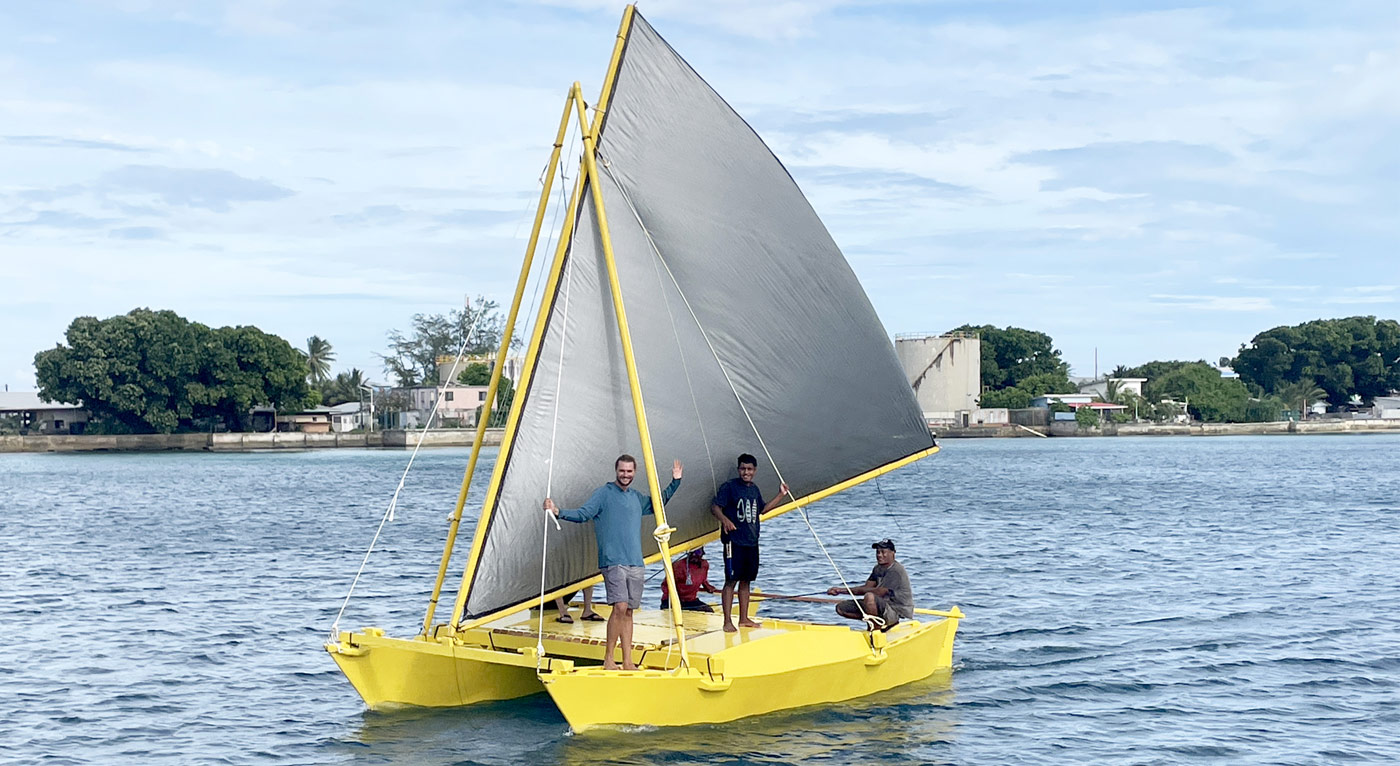
Crew and builders of the boat (not all of whom are pictured): Germany’s Henrik Richter-Alten (at bow), Isocker Anwel, Clancy Takia, Andy Caleb, Binton Daniel, Ken Daniel, George Lekjeb, Joe Lat.
KAREN EARNSHAW
The evolution of Marshall Islands canoes this week reached yet another milestone thanks to a small group of people “learning from the past for the present and the future.”
This philosophy is a motivating factor for Germany’s Henrik Richter-Alten, who first stepped through the doors of Waan Aelon in Majel in January, 2018. Henrik has been a student of the maritime world and renewable energy for the majority of his adult life, graduating in 2017 in ship building. “Soon after, I came to the Marshall Islands as an intern for GIZ (the German aid development agency)” having heard about the organization through one of his professors at the University of Emden/Leer.
He and Raffael Held, who is now the head of the GIZ program in Majuro, were the first two interns for GIZ to work here on big ships (such as Juren Ae) and small boats (the canoes). “I was drawn towards the canoes,” Henrik said Saturday. He began collaborating with Alson Kelen, director of WAM, and for the next eight months they outlined a plan for the future of canoes. “The idea was to stop everyone from using so many motorboats. For Alson, it’s all about empowering people to use canoes.”
Henrik returned to Germany and continued to work with Alson on ideas for the design of new, efficient canoes that the Marshallese could build and sail to improve life on the outer islands while doing away with the need for fuel. In January 2020, he was back at WAM: “We had two prototypes. One for transportation and one for fishing.” These were a two-hulled catamaran, capable of changing course without moving the mast, and a one-hulled proa.
“An Australian, Rob Denney, was hired by GIZ to work with me on building the canoes and teaching people how to build them. We were teaching both WAM trainees and people from the outer island communities.”
And then Covid hit, forcing Henrik to return to Germany in early April. “While I was gone, WAM kept doing the training and they all became more familiar with the designs.” The team was still making proas, but “the catamaran seemed to be more successful. The islanders definitely saw the benefit of the (catamaran’s) dry storage.”
Meanwhile, Henrik used the pandemic period to finish his master’s degree in ship engineering.
He also spent time studying two canoes from the 1800s: “One was at the HUF museum in Berlin. It’s about 18-foot and the museum called it a walap, but I think that really it’s a tipñol. The other is at a museum in Erfurt. “I started working with the old canoes and looking at the designs to learn from the past to look to the present and the future.
“By combining indigenous knowledge and modern engineering methodology,” we can understand how to build a more efficient canoe. He used modern technology, such as computer simulations and hulls made with a 3-D printer, to test the efficiency of their movement through the water. They then tested the hull design of a “modern” traditional design and compared the two. “The hulls from the 1800s appeared to perform the best,” Henrik said. This research was done through a partnership between HUF and WAM, which share each other’s resources.
Henrik has continued to come and go after the Marshall Islands opened its borders. “I came back in October, 2022,” he said. “The WAM fire had happened in early 2022 and they lost so much, including artifacts, but they didn’t lose their spirit and their knowledge.” Over the next few months, WAM was showcasing their training methods and built six or seven boats.
“I’ve now been collaborating with WAM for eight years,” Henrik said. “Since February 2025, this work has been supported by the German government through the International Climate Initiative.”
And, last Friday afternoon, after many years of the team’s hard work, Henrik enjoyed the first ride on the latest WAM catamaran prototype. After the sail, he wrote: “This is the latest version of the WAM cat. I changed the hull shape slightly and now I think it’s as good as it gets…” Light-heartedly he added: “This model will now be ‘mass-produced.’”
In other words, over the next 18 months WAM will build a total of 10 catamarans and proas thanks to the funding by Germany’s Climate Initiative. The WAM team has created patterns out of plywood for every single piece of the WAM cats, so they can be traced and cut out without the need for measuring. “We then use a stitch and glue system, meaning we wire the pieces together, then glue them together, and finally take out the wire.” The construction has been kept simple, but the development has been an intricate journey over many years.
And the bright yellow WAM cat that sailed past Delap on a sun-filled lagoon last Friday, was quick, nimble, and carried a happy captain and crew who are looking forward to sailing themselves, their cousins, and their friends into the future.
COLLEGE OF THE MARSHALL ISLANDS
As well as collaborations with and the support of various German organizations and institutions, WAM has a strong relationship with the College of the Marshall Islands. The Canoe House looks after the technical side of training people to build the boats, while CMI trains people to sail the boats through their maritime center in Uliga. Ship builder Henrik Richter-Alten said that, for now, teaching Marshallese to sail is useful to the staffing of the sailing cargo vessel Juren Ae, which was built with the support of Germany’s aid development agency GIZ. “But it is difficult to learn how to sail on a big boat, so right now CMI is working on a curriculum for teaching sailing using the canoes.”
[jetpack_subscription_form title=“Subscribe” subscribe_button=”Sign Me Up” show_subscribers_total=”1″]