
GIFF JOHNSON
Every December, fisheries officials from the Marshall Islands and Forum Fisheries Agency countries troop off to the annual Western and Central Pacific Fisheries Commission — often for battles with some distant water fishing nations over policies that impact tuna fishing on the high seas in the region.
But this year, said MIMRA Director Glen Joseph, many of the big and contentious tuna issues that the WCPFC dealt with in the past several years are not on the table this year, having been resolved through agreed-to conservation measures.
For the annual meeting this week in Manila, Joseph said there are two key issues for Pacific Islands at the meeting, one of which doesn’t have much impact on the RMI but is nevertheless a key tuna priority for action. The two issues:
- Albacore tuna in the South Pacific, which is in desperate need of a harvest strategy or management procedure to control fishing.
- Tuna transshipment on the high seas, especially related to the longline industry.
“The Tuna Commission’s flagship measure — its tropical tuna measure — remains in place,” said Joseph, meaning this is not up for discussion at the meetings this week.
“Our priorities are albacore and high seas transshipment,” he said.
“There is a night and day difference between transshipment in-port compared to the high seas.”
He said high seas transshipment issue has been on the WCPFC’s agenda for 16 years.
“The whole Commission knows that high seas (issues) need to be fixed, but instead they shine a light on in-zone (issues),” Joseph said, adding: “Excuse me, we’re good in-zone. It’s time to fix the high seas.”
Joseph made the point that the benefits of in-port transshipments versus doing it on the high seas are well known. “There are documented benefits of in-port transshipments,” he said, adding that all purse seiners licensed to fish in Parties to the Nauru Agreement (PNA) waters are required to transship in the ports of PNA members. But the same does not apply to the longline industry, which fishes heavily on the high seas and transships there.
High seas transshipment raises concerns about lack of oversight for monitoring the fish caught, data that is used to inform tuna stock assessments and monitor by-catch to ensure fishing companies follow established rules.
“Port State Control is important and we’re ready,” said Joseph, speaking about MIMRA and the RMI government’s approach to monitoring all in-bound fishing vessels in Majuro.
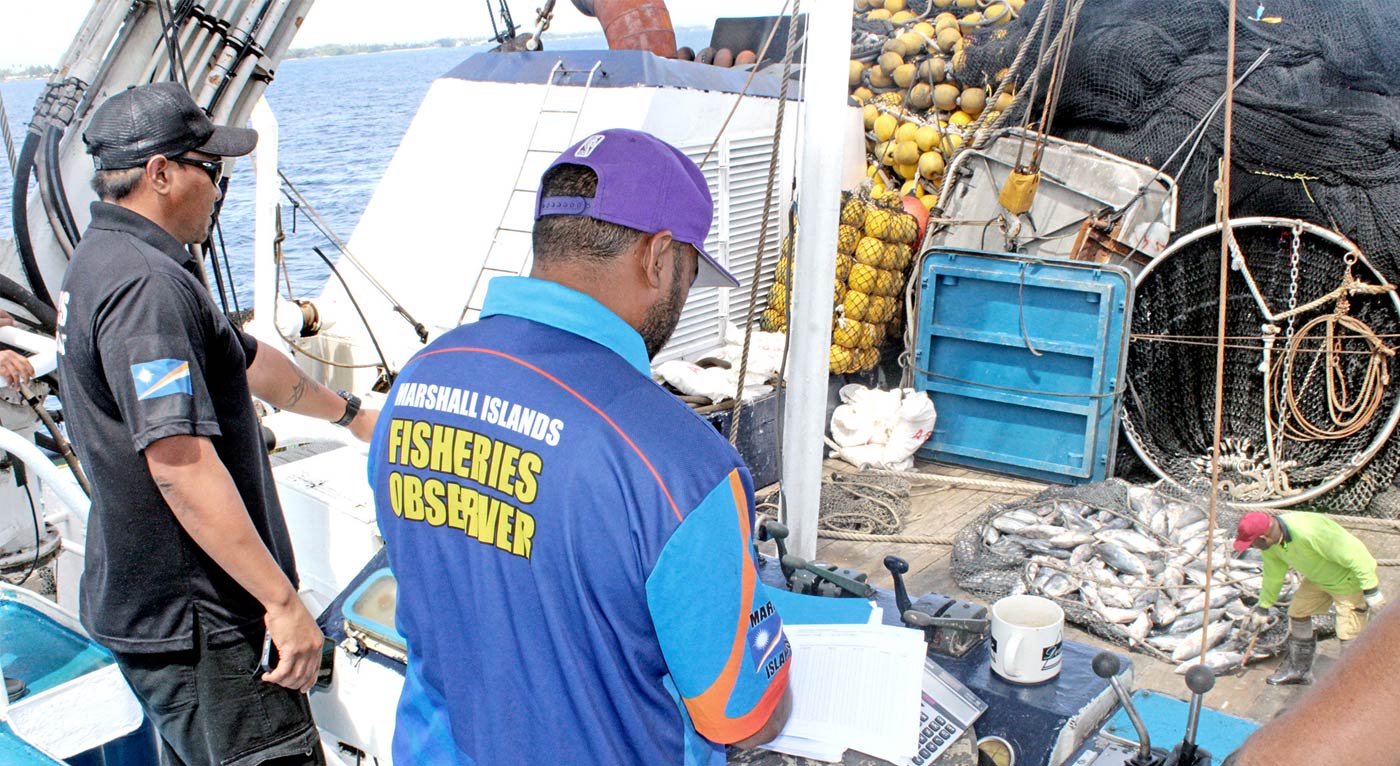
The purse seine industry in the region is managed differently than longliners, with multiple methods for monitoring operations, including the requirement that all purse seiners have an independent fisheries observer on board all fishing trips and the requirement of in-port transshipment, which is fully monitored by local fisheries officers.
High seas transshipments have few fisheries observers on board to monitor catch transfers so there is little verification of catch data. “Even if the high seas fishing and transshipment is not illegal, it is underreported and not recorded,” Joseph said. “It’s a glaring difference.”
The irony, said Joseph, is two things:
- Partner countries support port expansion and improvements in Pacific nations but then their fishing industry doesn’t use those improved ports to transship their catches.
- Some of the longline industry catch tuna inside the zones of island countries but then transship their catches on the high seas.
Joseph pointed out the obvious, which is that in-port transshipment provides many economic benefits to the RMI and other islands where purse seiners and longliners transship in ports.
He also noted that the convention on which the WCPFC is based “provides economic incentives for small island developing states. The WCPFC has a moral and legal obligation (to move transshipments from the high seas to ports).”
Joseph said Forum Fisheries Agency members, including the RMI, “will continue to push for transshipment reform,” adding that the current situation is “not fair. I urge all (WCPFC) members, especially our development partners and those who transship on the high sea, to consider the changes.”
The WCPFC operates on a consensus basis, which means that contentious issues can take time, in some cases years, to gain support of both island countries and distant water fishing nations.
On albacore, Joseph said this sector of the tuna fishery lacks a harvest strategy that would set boundaries on allowable levels of catch to ensure sustainability. “The line, over which fishing doesn’t go above, hasn’t been drawn yet,” he said.
As the PNA does with limiting tuna fishing effort by purse seine vessels fishing in PNA waters, the same needs to be done for the longline industry fishing albacore in the South Pacific, he said.
He indicated his hope that this would be fully addressed at this week’s meetings.
In addition to island nations, a US-based organization that supports sustainable fishing has called on the WCPFC to take action urgently to address fishing limits on albacore tuna.
The stakes “are high for the South Pacific albacore tuna fishery,” said officials with the PEW Charitable Trusts’ international fisheries project. At last year’s annual meeting, “WCPFC officials failed to adopt a new management style that would protect South Pacific albacore’s long-term sustainability. If the same thing happens this year, the $1 billion market for this tuna —which is mainly sold canned in the United States, where it is known as “white tuna” — may face severe disruption.”
The PEW Charitable Trusts said globally, consumers are demanding more sustainability for tuna products.
So-called “eco-labels,” such as those issued by the Marine Stewardship Council, provide fisheries with a valuable sustainability certification that opens access to key markets. Some major retailers require MSC certification of sustainability.
“However,” said the PEW officials, “some South Pacific albacore fisheries are set to lose their MSC label if the WCPFC does not adopt a new, more modern management approach, known as a management procedure, this year.”
Essentially a “management procedure” is a “harvest strategy” that would set limits on fishing to ensure catches are sustainable.
Since last year, South Pacific island states and Australia have led the push for management procedure adoption, and they are continuing to champion the effort at the annual meeting in Manila this week, said PEW.
“Scientists have already evaluated close to 40 potential management procedures for their effectiveness in meeting specific objectives related to the health of the South Pacific albacore fishery, and all that’s left is for managers to choose the best one,” said PEW.
“The analysis has been done. The science is clear. And the consequences of inaction could be disastrous for South Pacific communities. WCPFC managers must step up and adopt a management procedure for South Pacific albacore without delay,” said PEW Charitable Trusts.
[jetpack_subscription_form title=“Subscribe” subscribe_button=”Sign Me Up” show_subscribers_total=”1″]