
GIFF JOHNSON
The Marshalls Energy Company signed a deal earlier this month with its diesel fuel supplier that’s going to bring less expensive gasoline prices to the Marshall Islands, the company said in a statement.
This is going to “especially (help) our outer island communities who have been paying around $10 to $18 per gallon,” MEC said.
Starting in March 2026, MEC said it will be purchasing gasoline in large volumes, which means it can bring gas to the RMI for lower prices than Majuro, Ebeye and outer islands see at the retail level. “This is a game-changer for our fishermen, our families, and our communities,” said MEC. “Less money on fuel means more money for everything else you need.”
MEC CEO Jack Chong Gum added details in response to questions from the Journal.
“MEC’s gasoline will be available to all customers throughout the Marshall Islands who want to take advantage of our more affordable prices — not just the outer islands,” he said. “Our goal is to be the primary wholesale supplier of gasoline for the RMI. While we’re focusing on making gasoline more affordable especially for outer island communities who’ve been hit hardest by high prices, anyone in Majuro, Ebeye, or anywhere else in the RMI will be able to purchase gas from MEC.”
In MEC power plant news, CEO Chong Gum provided the following update.
Construction work on the Marshalls Energy Company’s new “Power Station 1” building has started with a late 2026 completion date targeted.
The new building will house five new engines that will give MEC an unprecedented level of power generation capacity to power Majuro Atoll from the single new power plant building. Still given the work needed to construct the building and then all of the installation work, the new “PS1” is not expected to go into service until 2027.
“The physical structure of the new PS1 power plant building is on track for completion in the latter part of 2026,” Chong Gum told the Journal. “However, keep in mind that once the structure is up, there will still be significant interior work — electrical systems, control rooms, ventilation, and all the technical installations needed before the facility becomes fully operational.”
As a result, Chong Gum said, “while you’ll see the building standing next year, full commissioning will take additional time beyond that.”
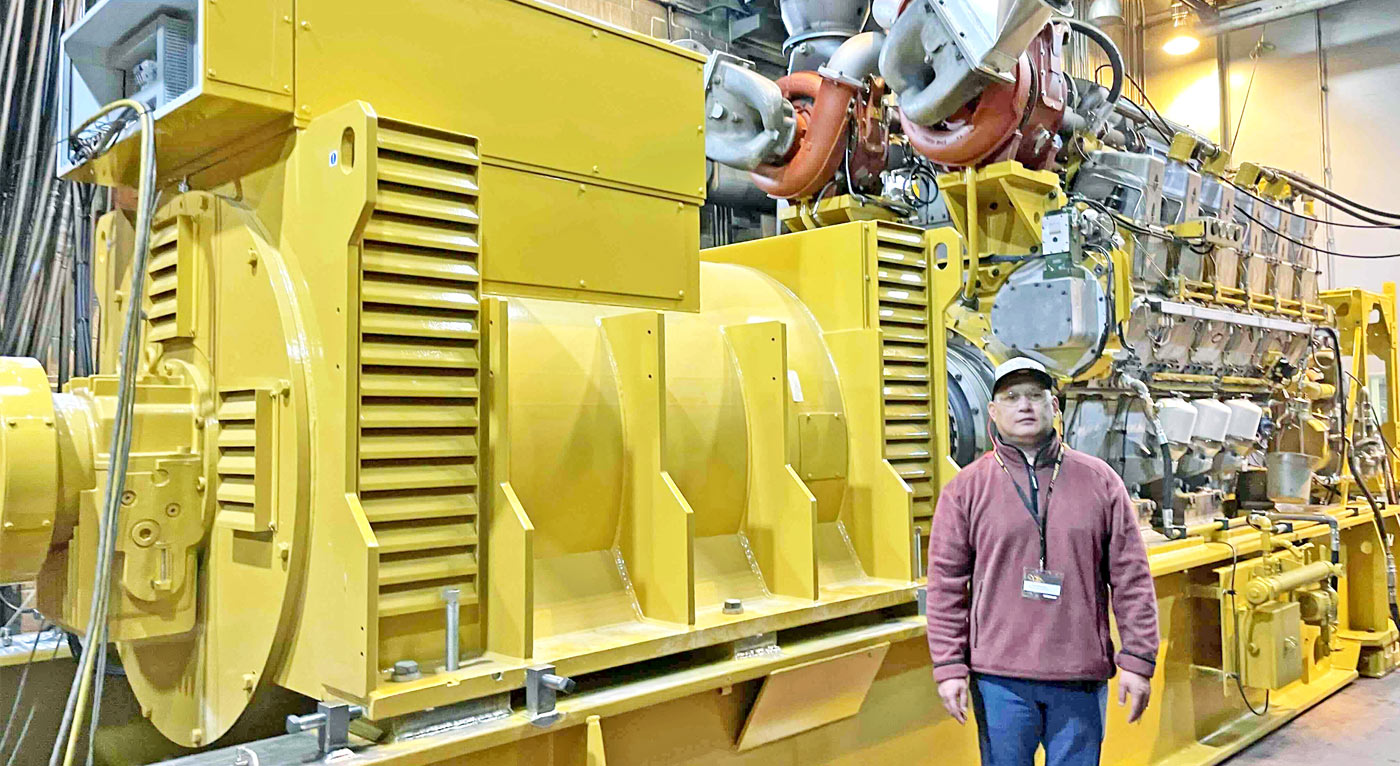
The five new generators are funded by donors. Two have been manufactured with World Bank funding as part of a project to greatly expand MEC’s reliance on solar energy. Three other engines are being purchased with US Compact funding.
All told, the five new generators, once operational, will give MEC a combined power generating capacity of nearly 16 megawatts. Power Station 2, which houses the two old Deutz generators that when new were rated at about six megawatts each, will provide backup generating capability.
“We’ll begin installing the World Bank-funded generators once the PS1 building structure is erected with walls in place,” said Chong Gum. “The actual installation work can start before all the interior finishing is complete.
The two World Bank-funded generators are Caterpillar units rated at 2.5MW prime power each. The three US-funded generators will also be Caterpillar, but rated at 3.6MW continuous power each.
“Continuous power rating is a big deal,” he said. “Most of MEC’s current generators are rated for “prime power,” which means they’re designed to run at about 70-80 percent of their maximum capacity most of the time, with the ability to handle occasional peak loads. ‘Continuous power’ means these new generators can run at 100 percent of their rated capacity 24/7 without any breaks. It’s like the difference between an electric vehicle that’s designed for city driving versus one built for non-stop, long-distance highway use. For a power company that needs reliable electricity around the clock, having continuous-rated generators means we can depend on that full 3.6MW from each unit all day, every day.”
All five generators will be Caterpillars.
“Standardizing on Caterpillar equipment across all five new generators is important because it means our technicians only need to be trained on one type of equipment, we only need to stock one set of spare parts, and maintenance procedures are the same across all units,” Chong Gum said. “This saves money and makes our operations much more efficient.”
The total combined capacity of all five new generators is 15.8MW.
While the World Bank-funded generators are already built, the three US-funded generators have not been ordered yet, Chong Gum said. “We’re expecting to receive proposals from suppliers around mid-January 2026, and then we’ll conduct our evaluation process,” he said. “Our target is to confirm the order by March 2026. Generator purchases have a very long lead-time, ranging from 14-18 months from placement of order.”
[jetpack_subscription_form title=“Subscribe” subscribe_button=”Sign Me Up” show_subscribers_total=”1″]