
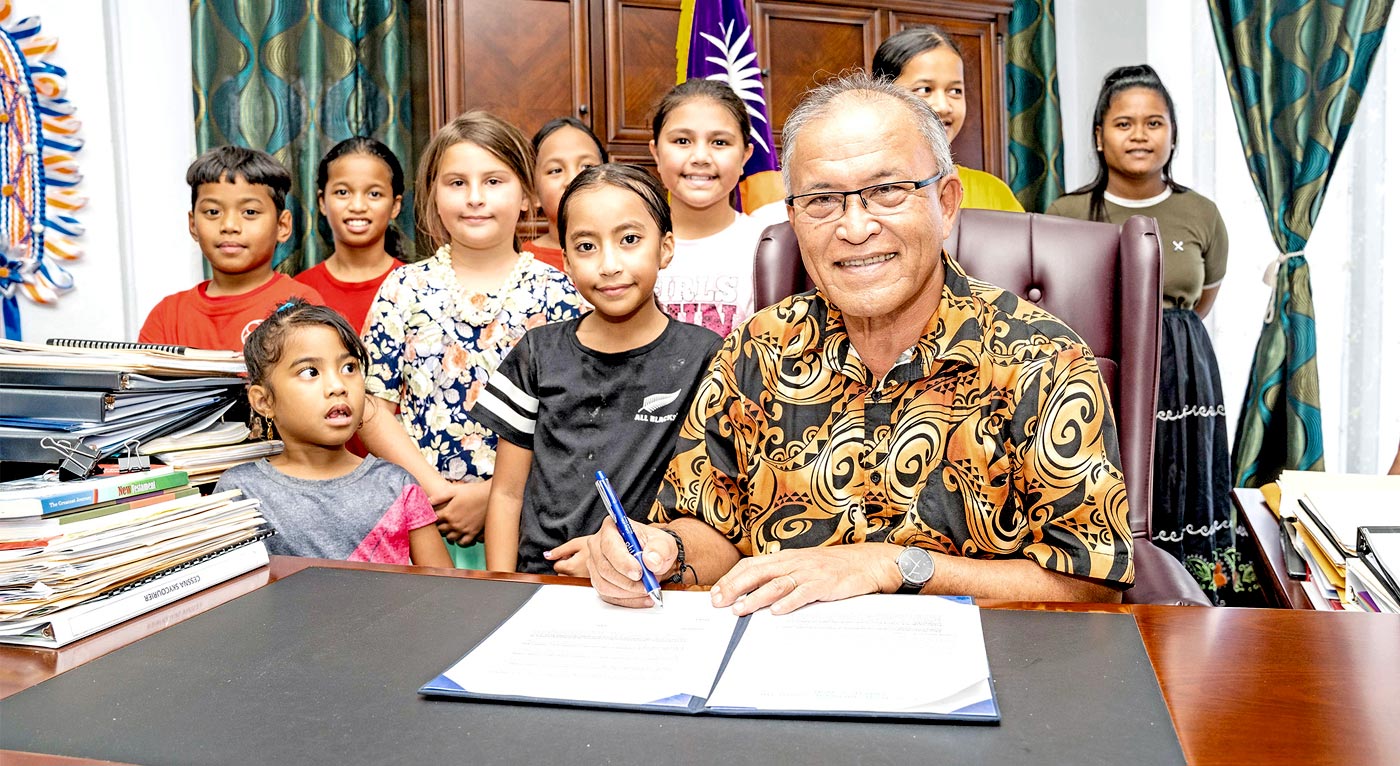
Long-term Nitijela Member David Kabua was sworn in as President in early January 2020 at one of the most consequential moments in Marshall Islands history: The intersection of a massive disease spread and the specter of a new, unknown virus threat coupled with the huge challenge of navigating negotiations with the United States for a third funding agreement under the Compact, then scheduled to end during his four-year term.
In January that year, as the newly elected President raised his right hand in parliament to take his oath of office, the country was reeling from massive spread of dengue fever that nearly overwhelmed Majuro hospital. Six weeks later, as dengue was finally coming under control, news of a new virus — unknown at the time — was causing global headlines as people in China fell sick and died.
“For a brand-new President, this was a baptism by fire,” wrote Jack Niedenthal in a eulogy about the late former president he posted to social media following news of Kabua’s death in Honolulu. He had been undergoing cancer treatment for months before his death this past week.
“The situation he faced was far beyond anything normal; from day one, his leadership required thinking entirely outside the box,” said Niedenthal who was the nation’s secretary of Health at the time. He said what made President Kabua a great leader “is that he listened when we pleaded that we, as a country, had to take drastic action—something never before done in our history as a nation. At the Ministry of Health, we were asking the President to close our borders for our own protection. We knew we would not be able to handle an outbreak of whatever this disease was.”
He said a Covid outbreak in RMI at the earliest stage of what became global pandemic “would have devastated our population. President Kabua listened. He agreed to close our borders.”
Getting the country to 90 percent levels of immunization against Covid from the time the first shots were developed, in December 2020, took over a year to cover the outer islands as well as the urban centers. It also took time to train staff, get ventilators and other equipment that would likely be needed in the event of an outbreak, establish quarantine facilities. The border closure allowed this to happen.
“As a nation the Marshall Islands mounted one of the most effective responses to Covid anywhere in the world,” Niedenthal said. “This is not simply my view; it was affirmed by the US Centers for Disease Control, which described our response as ‘unprecedented.’”
This was “the result of disciplined, decisive leadership. And at the center of that leadership was a President who listened and cared.”
Niedenthal said the late president must be remembered for his leadership during the most challenging times. “President Kabua was a quiet and humble man. He was kind. He treated all of us with respect. But above all, to me, his greatest quality was that he listened—and then acted with clarity and purpose during a time of real danger and uncertainty for our people. His leadership in that moment deserves to be remembered.”
The family of the late president is organizing a funeral service in Honolulu that is likely to happen early next week, after which it is anticipated that his remains will return to Majuro for a state funeral and final burial.
He is survived by his wife, the former First Lady Ginger Kabua, three children Dexter L. Kabua, Dorianne T. Kabua, and Kudo S. Kabua, and four grandchildren.
[jetpack_subscription_form title=“Subscribe” subscribe_button=”Sign Me Up” show_subscribers_total=”1″]