
GIFF JOHNSON
Where to start a conversation about Professor Andrew Garrod, who died at age 87 last week in New Hampshire after an extended illness?
Andrew touched quite literally thousands of people in the Marshall Islands over the nearly 30 years that his presence was felt here.
And hundreds of those were the young people who participated in his intensely demanding rehearsals and then weeklong performances of eight Shakespeare plays and later nine musicals.
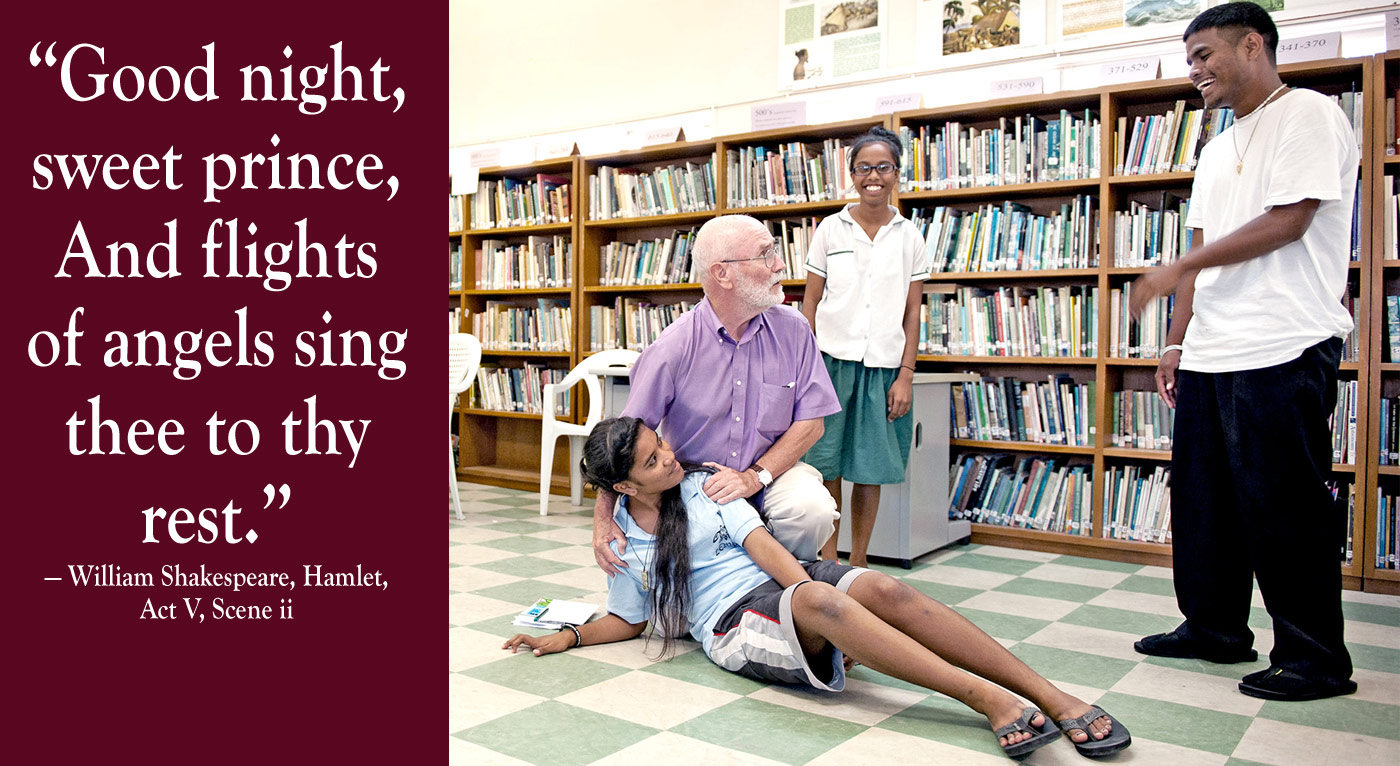
From such well known Shakespeare plays as Romeo and Juliet and As You Like It to The Music Man and Oliver! (his last production in 2024), Andrew honed the acting skills of elementary, high school and college students — giving them a platform and an environment to build their self-confidence, improve their public speaking skills, and increase their language knowledge of both English and Marshallese. All of this work in rehearsals, generally carried out in January and February at the Marshall Islands High School library six days a week, led to simply astounding theatrical productions.
To be sure, Andrew always had a team around him: To build the stage backdrop, to outfit the actors and actresses with costumes that fit the time period of the play, to oversee and choreograph the music and dance portion of every play. But it was Andrew who shaped and put it all together.
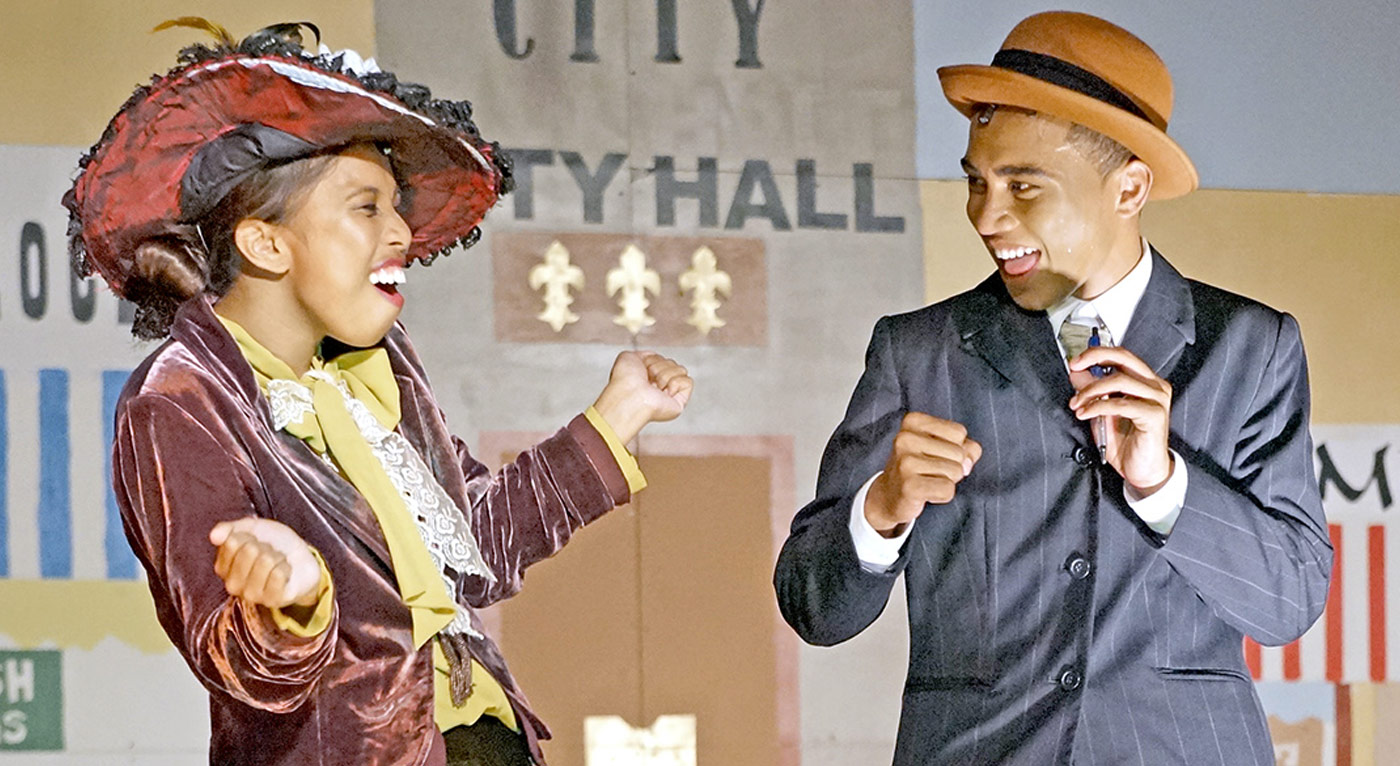
Photo: Chewy Lin.
When the performances hit the stage — from 2004 to the early 2010s at the MIHS campus, and since then up to 2024 at the International Conference Center — they were a marvel to watch.
“Extraordinary. Magical. Riveting. These are just some of the words that can be used to descried opening night of Dr. Andrew Garrod’s latest Youth Bridge Global Production of The King and I,” wrote Jack Niedenthal in the March 4, 2016 edition of the Journal, noting it was then Andrew’s 12th theatrical production to that point.
Although best known for the remarkable theater performances, Andrew first became involved in the RMI by sending Dartmouth College students to Queen of Peace School on Ebeye to gain practical experience while helping the school with its teaching needs.
That initial effort with sending Dartmouth students to Ebeye in the mid-1990s segued into an agreement between Dartmouth and the Ministry of education for groups of Dartmouth Education students to teach for 10-week periods in January to March each year. Most initially went to Marshall Islands High School. Later, they were also dispatched to multiple elementary schools on the outer islands as well as Majuro Middle School.
Andrew had a long resume as a director of theater productions — specializing in Shakespeare. So what for Majuro seemed an aberration — the recently retired chairman of the English Department at Dartmouth College starting rehearsals for Shakespeare’s Midsummer Night’s Dream at MIHS — was, for Andrew, something he’d been doing for years, admittedly in a very different environment.
He had the aid of the team of Dartmouth students teaching at MIHS to assist with the plays, and long-term Majuro educators like Jerre Bennett, a music expert, connected with Andrew to support the plays that rolled out annually in subsequent years.
Andrew started with predominantly MIHS students in his early days of Shakespeare plays, then later broadened the acting pool to include a variety of public and private schools, as well as students at USP and CMI.
The Dartmouth students selected to teach in Majuro were an amazing array of talented young people. One was Peter Sutoris, who came out with Andrew to make a film about the Marshall Islands, that ultimately became “The Undiscovered Country.” Peter was a graduate of the United World College in Wales, UK.
It was his interest in the Marshall Islands and his knowledge of the UWC program that led him and Andrew to talk with the International Office of UWC in London that set the wheels in motion to establish a UWC National Committee in the Marshall Islands recognized by the UWC program that is active in about 150 countries, with 18 international schools around the world.
At the time Dr. Irene Taafaki was director of the USP Campus in Majuro and took up the role as chairperson of the initial UWC National Committee, creating the first group to manage the UWC scholarship process, with USP staff Tamara Greenstone-Alafaio becoming a major force with the initiative by conducting outreach to local high schools to interest students in applying.
Those early efforts — with Andrew attending the annual UWC Selection Day programs with local high school students as a member of the National Committee — fully established the RMI as a member of the UWC movement with, to date, 17 students completing studies in multiple UWC schools around the world and four presently in schools in Japan, Singapore and Bosnia.
He edited multiple books giving indigenous voices a platform to tell their stories. One that is a compendium of essays by Native American graduates of Dartmouth, “I Am Where I Come From,” shows the many similarities to life in Marshall Islands.
A more recently published book, “I Talk of Dreams: Reflections on Adolescence/theatre/and performing Shakespeare (24 essays),” includes writing by former theater participants from Rwanda, Canada, Bosnia and Herzegovina, Kosovo and the Marshall Islands, all describing the impact on their young lives from performing on stage.
So revered for his work in the Marshall Islands, he was given honorary Marshallese citizenship by the government several years ago.
“I am trying to give them the opportunity to find their voice, to find an identity, to gain confidence in their body and their own wishes and analysis of the world, and to raise their academic aspirations,” Andrew told Jack Niedenthal in an interview published in Pacific Island Times in 2024. “I always felt that if they’d gotten to feeling better about themselves as adolescents — a challenge in adolescence — they’d be more in a position to aim high and to better their lives and to better the lives of their community.
“That’s what drew me to international settings because I’ve always been more interested in working with young people who have never had the opportunity to be part of a theater production so that they can have that kind of experience.”
The Marshall Islands was the epitome of this lack of opportunity. And it didn’t matter that 99 percent of the would-be actors and actresses who mustered up the nerve to walk into the MIHS Library in response to the early January announcement that auditions were starting had zero acting experience. Andrew held everyone to a high standard and expected them to step up to meet it.
“I always say the show itself needs to be the very best it can be, otherwise you won’t reflect positively on the show,” he said in the Pacific Island Times interview. “So winning the audience’s approval is important. You’ve got to know your lines. You’ve got to live up to a high level of expectation and quality of performance so that the audience has a good time because you owe it to them to entertain them.”
Andrew will be long remembered as a positive force changing the narrative of young people in the Marshall Islands to think big and act on their dreams.
Observations by a few of the hundreds of Marshallese young people who participated in one or more of Professor Andrew’s plays follow:
“I truly believe that through the plays we performed he gave us hope that we too can reach such heights as being entertainers, musicians, or producers. He gave us hope that we do truly have the potential and talents to be those people with big dreams and have those dreams be within our grasp. As someone from a small island it can be hard to dream big and reach such creative heights. He made those dreams within reach. Working with him, I personally felt like I can do anything and dream big too.”
—Carnie Reimers, who acted in four of Professor Andrew’s theater productions
“Through his work, Andrew channeled his love for young people into helping them become better versions of themselves. I can confidently say that many of the youth that worked with Andrew Garrod are now successful in one way or another (because he) instilled in each of them a sense of purpose.”
—Bryant Zebedy, who acted in five of Professor Andrew’s theater productions.
“I joined eight productions that Professor directed, and I must say that all those eight plays were the best experience of my life. He allowed me to just be free. I was never a talkative person or a stage person because I was very shy. I stutter a lot when I talk but being in the show has shown a lot of different things about myself. It taught me to be free in the imaginary world, to be courageous and be out of your comfort zone and accept any differences that you have.”
—Yolanie Jurelang
“He gave a safe space for Marshallese youths to grow in. To be youths but with responsibilities. He had high expectations and put a lot of pressure on us but it was good, necessary pressure. Especially for us that young. It gave us direction and a creative outlet that many of us leaned into as catharsis from the everyday minutiae of our lives. On stage and with each other, he taught team effort, time management, communication, presentation of self, boost of self-esteem and recognition from our peers and our island.”
—Selina Leem
[jetpack_subscription_form title=“Subscribe” subscribe_button=”Sign Me Up” show_subscribers_total=”1″]